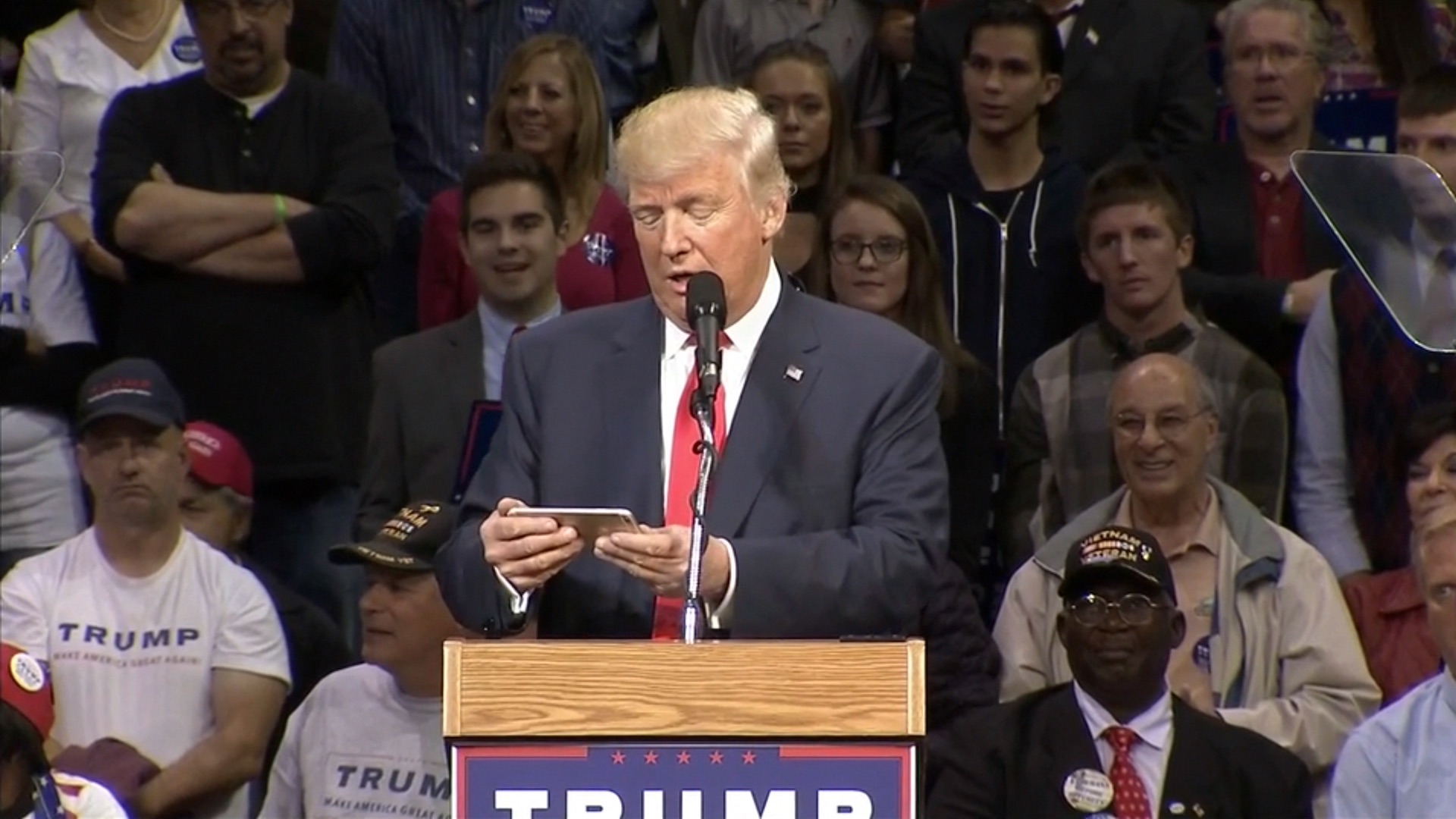
Video still taken from this Washington Post article.
Since the creation of Twitter 11 years ago, there has been an ongoing discussion and debate about how, and if, the platform has changed American politics. Though there are some detractors, I do believe that Twitter has changed the American political landscape in at least three ways.
First, Twitter has changed the way journalists write and report politics. According to Associated Press political editor Liz Sidoti, “When everything is in 140 characters, it gives a skewed version of reality, and that impacts how editors think about what reporters should be covering, and it impacts what reporters think is important.” Though the character limit has been raised to 280 characters, the sentiment remains true. Only the most spectacular and sensational stories gain traction on Twitter, so reporters have adapted by only reporting on spectacular and sensational events and people. In addition, Twitter’s constantly updated feed has shortened the news cycle, forcing reporters to constantly find and report on new content in order to stay relevant. Twitter’s short-form content also decontextualizes the stories being reported, often leading misconstrued narratives of events. This has, in turn, led to politicians sensationalizing themselves in order to get news coverage. Take, for example, the 2016 presidential election. Donald Trump used his Twitter to share his often controversial views and opinions, and as a result, he was constantly in the news cycle. This near constant coverage translated to him doing well in the Republican polls and helped him to win not only the primaries but the presidential election.
Next, Twitter has helped political groups on party fringes to rise to greater prominence. Take for example the Tea Party. According to an article in The Atlantic, “The Tea Party was … arguably the first movement to fully harness the power of Twitter to bind and amplify groups of people who were geographically distant but ideologically similar.” The Tea Party was the first in a long list of political groups and movements that have gained traction on Twitter, and have recently grown even stronger in the public sphere. Activists on both the far right and the far left have united over Twitter, emphasizing the already polarized American political climate.
Finally, and more positively, Twitter has changed the access ordinary citizens have to politicians. It is now easier than ever before for constituents to contact their representatives, and for representatives to hear from their constituents. For many people, this represents a positive change in American politics. According to The Atlantic article, “Twitter democratizes and shakes up the genteel inertia of modern political dialogue…and shifts much of the power once hoarded by political establishments back into the hands – or voices – of people.”
In conclusion, yes – Twitter is changing the landscape of American politics. As with any new medium, people have a range of opinions on whether the changes are good or bad. And as with every medium, the changes are a mixed bag of the good and the bad. Yes, Twitter has further shortened the news cycle and changed the way we receive and react to the news. But it has also provided a more democratic way of interacting with our politicians and allows everyone a platform to gather with like-minded people and make their opinions heard.

 Levels and Buttons