The Devil’s details

“I am convinced the devil lives in our phones.”

Once again, I was struck by the title of an article running through my News app.

If we are tasked with discerning good and evil in the world we live in, then what might be evidence of the devil living in our phones?

Addiction.

Addiction that leads to distraction.

Distraction that leads to separation from a natural reality.

Whether it be the suspicion of something evil at work or of something more corporeal, the effects of children being exposed to screens at a young age are causing parents in Silicon Valley to freak out.

A recent article in the New York Times explains that since “technologists know how phones really work,” many have decided “they don’t want their own children anywhere near them.”

Much of this concern is centered around the addictive nature of screen activities.

In the aforementioned NYT article entitled “A Dark Consensus About Screens and Kids Begins to Emerge in Silicon Valley,” Chris Anderson, the former editor of Wired, adds his expertise to defend the limitation of screen time by parents.

Mr. Anderson warns of the addictive nature of screens by saying “On the scale between candy and crack cocaine, it’s closer to crack cocaine.”

He maintains his cry of despair when addressing the difficulties of managing screen time as a parent: “This is beyond our power to control. This is going straight to the pleasure centers of the developing brain. This is beyond our capacity as regular parents to understand.”

Anderson has several hefty rules for technology use in place for his five children, including a no phone policy until his children reach the summer before high school and a call for no screens in the bedroom.

Other parents of young children are living by similar mantras, such as “the last child in the class to get a phone wins.”

The suspicion that tech developers are employing evil tactics to captivate the youth of the world has bled over to the formation of a new impression that these companies could be manufacturing a digital divide between the rich and the poor.

In a separate report by the New York Times about “The Digital Gap Between Rich and Poor Kids,” writer Nellie Bowles reveals that recent trends point to the creation of a social framework where “the children of poorer and middle-class parents will be raised by screens, while the children of Silicon Valley’s elite will be going back to wooden toys and the luxury of human interaction” (Digital Gap).

This ploy by tech giants to have children hooked on digital experiences, (which is a move supported by telling reports), carries an inherently evil quality.

If the devil is in the details of recent digital technology design, then the side-effects of addition and isolation are clearly intentional.

On the contrary, a psalm comes to mind when thinking of the parents who challenge the cultural norms of excessive screen time for their children:

Psalm 1:1-2

“1 Blessed is the one who does not walk in step with the wicked or stand in the way that sinners take or sit in the company of mockers,

2 but whose delight is in the law of the LORD, and who meditates on his law day and night.”
Is Twitter Changing the Political Landscape?


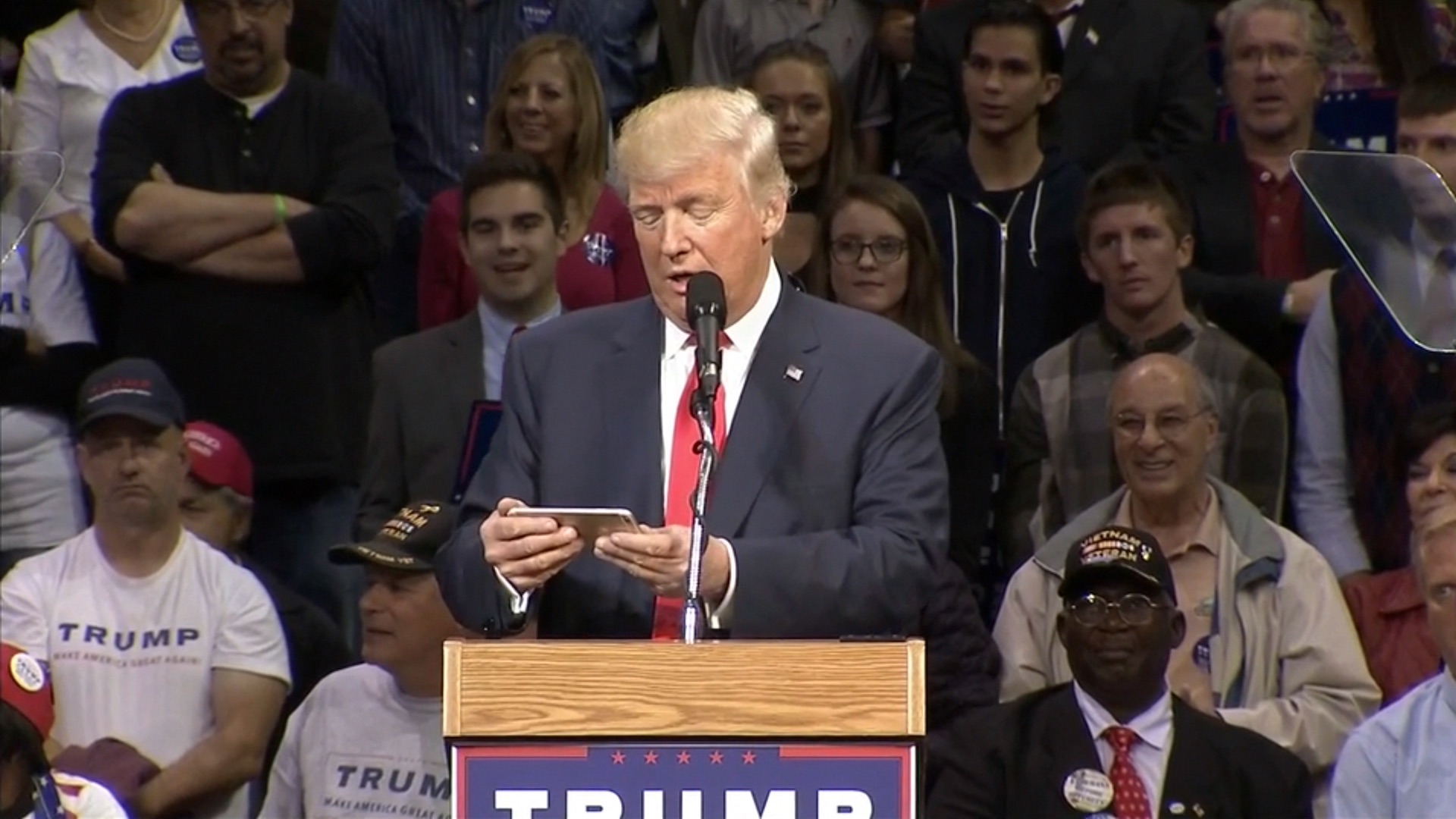
Image result for donald trump on his cell phone

Video still taken from this Washington Post article.


Since the creation of Twitter 11 years ago, there has been an ongoing discussion and debate about how, and if, the platform has changed American politics. Though there are some detractors, I do believe that Twitter has changed the American political landscape in at least three ways.

First, Twitter has changed the way journalists write and report politics. According to Associated Press political editor Liz Sidoti, “When everything is in 140 characters, it gives a skewed version of reality, and that impacts how editors think about what reporters should be covering, and it impacts what reporters think is important.” Though the character limit has been raised to 280 characters, the sentiment remains true. Only the most spectacular and sensational stories gain traction on Twitter, so reporters have adapted by only reporting on spectacular and sensational events and people. In addition, Twitter’s constantly updated feed has shortened the news cycle, forcing reporters to constantly find and report on new content in order to stay relevant. Twitter’s short-form content also decontextualizes the stories being reported, often leading misconstrued narratives of events. This has, in turn, led to politicians sensationalizing themselves in order to get news coverage. Take, for example, the 2016 presidential election. Donald Trump used his Twitter to share his often controversial views and opinions, and as a result, he was constantly in the news cycle. This near constant coverage translated to him doing well in the Republican polls and helped him to win not only the primaries but the presidential election.

Next, Twitter has helped political groups on party fringes to rise to greater prominence. Take for example the Tea Party. According to an article in The Atlantic, “The Tea Party was … arguably the first movement to fully harness the power of Twitter to bind and amplify groups of people who were geographically distant but ideologically similar.” The Tea Party was the first in a long list of political groups and movements that have gained traction on Twitter, and have recently grown even stronger in the public sphere. Activists on both the far right and the far left have united over Twitter, emphasizing the already polarized American political climate.

Finally, and more positively, Twitter has changed the access ordinary citizens have to politicians. It is now easier than ever before for constituents to contact their representatives, and for representatives to hear from their constituents. For many people, this represents a positive change in American politics. According to The Atlantic article, “Twitter democratizes and shakes up the genteel inertia of modern political dialogue…and shifts much of the power once hoarded by political establishments back into the hands – or voices – of people.”

In conclusion, yes – Twitter is changing the landscape of American politics. As with any new medium, people have a range of opinions on whether the changes are good or bad. And as with every medium, the changes are a mixed bag of the good and the bad. Yes, Twitter has further shortened the news cycle and changed the way we receive and react to the news. But it has also provided a more democratic way of interacting with our politicians and allows everyone a platform to gather with like-minded people and make their opinions heard.